
In 2026, the pixel‑art sandbox Terraria continues to rewrite its own record books, a feat that seemed almost unimaginable when the game first launched over a decade ago. Back in early 2021, developer Re‑Logic announced that Terraria had leaped past the 35‑million‑copies‑sold mark across all platforms, cementing its place as one of the most popular indie games of all time. Fast‑forward to the present day and that number has swollen to more than 60 million units, a testament to its timeless creativity and a community that refuses to put down their pickaxes.
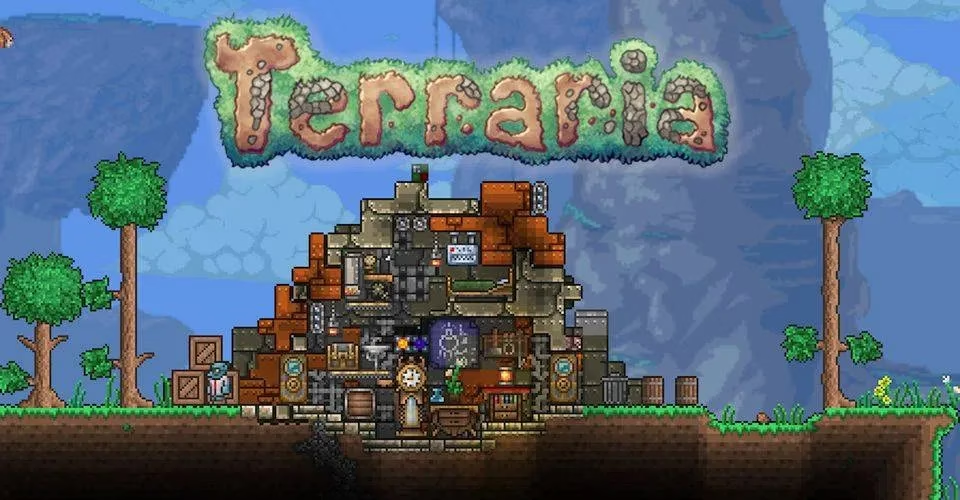
The detailed breakdown of the 35‑million milestone was staggering: 17.2 million copies on PC, 8.5 million on consoles, and 9.3 million on mobile devices. That three‑way split illustrated how Terraria had escaped the confines of a single screen and burrowed into every conceivable gaming device. Since then, the growth has been relentless. Console versions received the long‑awaited Journey’s End update, finally achieving content parity with the PC version. Mobile controls were overhauled again to welcome a fresh wave of explorers. And perhaps most significantly, the introduction of full Steam Workshop support turned Terraria into a living canvas where modders could weave entire new dimensions, quests, and biomes—further fueling the game’s immortality.
Yet the sales figures tell only half the story. In the same period, Terraria achieved another triumph that few games can claim: it became the highest‑rated title on Steam. By overthrowing critically acclaimed juggernauts such as Portal 2 and The Witcher 3: Wild Hunt, Terraria secured the top spot on the Steam Top 250—a list driven entirely by gamer reviews. This crown is not bestowed by critics or algorithms; it is earned one review at a time by millions of players who have collectively decided that this 2D world holds more magic than most blockbusters. Even in 2026, the ‘Overwhelmingly Positive’ rating clings to the store page like a badge of honor, sustained by an endless stream of fresh reviews from veterans and newcomers alike.
Re‑Logic’s philosophy has always been to treat the community as the heartbeat of the game. After the 35‑million proclamation, a heartfelt blog post on the official forum acknowledged exactly that. \u201cEvery time we think we have seen it all with regards to the sheer level of support and love you all show us, you always find ways to take it to the next level.\u201d That sentiment became a guiding star for the content that followed. Console Journey’s End landed, bringing features like the Master Mode and the Princess NPC into parity with the PC version. Steam Workshop support injected a new era of creativity, allowing user‑generated maps and texture packs to flow seamlessly into the experience. And the most ambitious dream of all—crossplay—finally materialized down the line, knitting together the disparate platforms into a single, bustling community. In 2024, updates like \u201cLabor of Love\u201d and subsequent quality‑of‑life patches proved that the \u201cJourney’s End\u201d moniker was more poetic than literal; the journey for Terraria had no end.
The game’s ecosystem evolved in fascinating ways, too. The brief and turbulent flirtation with Google Stadia—recounted by Re‑Logic as a saga where the founder’s 15‑year Google account was abruptly blocked, only to be later restored after direct intervention—resulted in a Stadia launch that, although the streaming service ultimately shut down in 2023, demonstrated the developer’s unwavering respect for delivering the game wherever players wanted it. The Stadia episode is now a curious footnote in a timeline studded with platform‑hopping triumphs. Mobile sales continued to soar past 20 million, while console editions cemented themselves as living‑room staples thanks to 4K support and split‑screen shenanigans.
Looking at Terraria in 2026, it is impossible not to marvel at how a game built on simple 2D tiles ended up influencing a generation of survival‑crafting titles. Its alchemy of exploration, combat, building, and relentless progression created a blueprint that many have tried to imitate but none have quite matched. The fact that Terraria still sells millions of copies each year, long after its final major content patch was supposed to ship, speaks to a rarity in the gaming industry: a complete experience that asks so little of a system yet gives back so much. Whether it is a newcomer buying the mobile version during a commute or a veteran launching a modded playthrough with friends, every sale adds another brick to Terraria’s indomitable fortress. With a community‑driven rating that crowns it king of Steam and a sales tally that pushes past the 60‑million milestone, Re‑Logic’s masterpiece stands as proof that a lovingly crafted game never really grows old—it just finds new worlds to conquer.