
In late 2017, Nintendo Switch owners who had been waiting for Terraria received a carefully worded update from Re-Logic and 505 Games: the sandbox hit was still coming, but its release window had become fuzzy. The developer announcement said the Switch version would arrive in the 'very near future,' yet it offered no confirmation that the game would make its previously targeted 2017 launch. Nearly a decade later, in 2026, that uncertainty is part of Terraria's long history rather than its present. The Switch port eventually launched on June 27, 2019, and it has since become a stable part of the game's multiplatform ecosystem. The story of the delay, however, remains a useful look at how a major update can reshape an entire release pipeline.
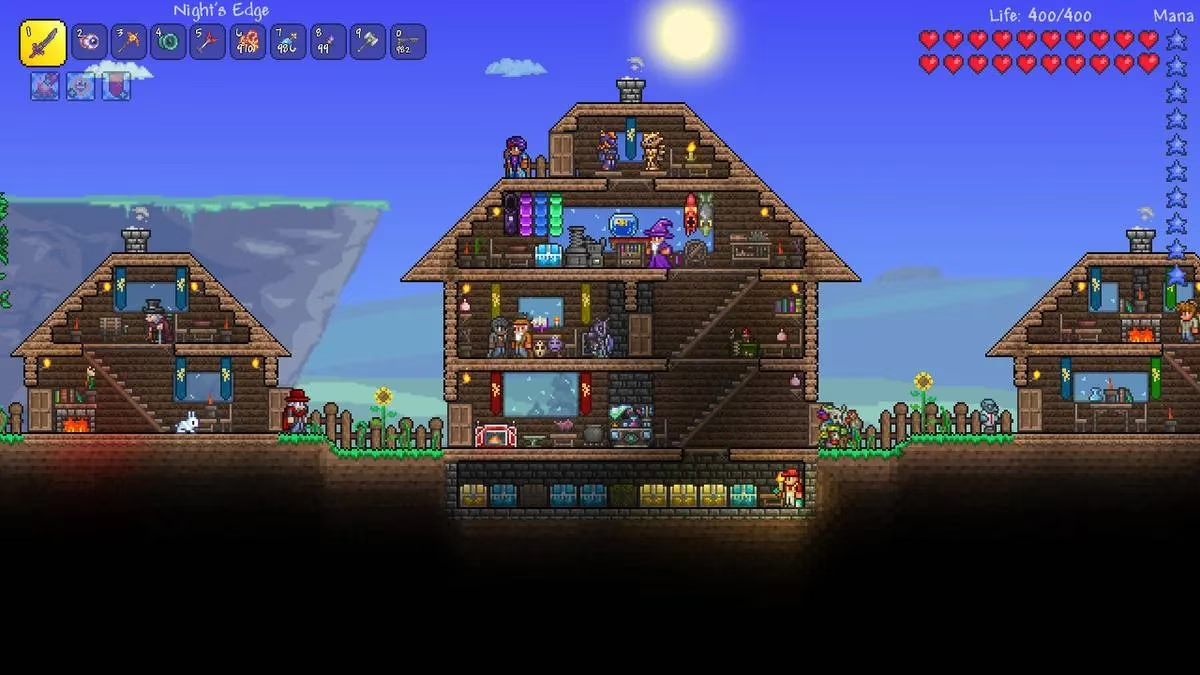
Terraria was one of the early indie titles confirmed for the Nintendo Switch during the console's first Nindies presentation. At the time, the announcement felt like a natural fit: a portable, building-focused adventure with millions of players on PC, consoles, and mobile devices. A widely shared social media post helped amplify the news. Half a year later, Terraria's official account re-confirmed the commitment and narrowed the window to 2017. For fans, the message was clear: the Switch version was not a matter of if, but when.
That confidence soon met reality. The 1.3 update, a massive content and engine overhaul, introduced significant speedbumps. Re-Logic and its development partners were rewriting the entire codebase for the game. The goal was not simply to add new bosses, items, or events; it was to ensure that every version, including the Switch release, would be stable on day one. In a project as sprawling as Terraria, that meant testing, hotfixing, and coordinating across multiple hardware families.
By late 2017, the official patch notes for Terraria 1.3 had arrived on PlayStation 4. Those notes also carried a forward-looking message about what came next. Once the team finished the initial console hotfixes, attention would shift to bringing mobile up to the 1.3 era and finally bringing Terraria to the Nintendo Switch. Some work had already been done on the Switch version, but with the foundational codebase now in place, the developers expected that work to accelerate to full speed. They promised an update on timing in the 'very near future.'
The wording was hopeful but not definitive. It never explicitly said the game would miss 2017, which left room for optimistic fans to hold out. A more neutral reading, however, suggested a crowded schedule. Re-Logic and Pipeworks still had to upgrade the mobile version, finalize the Xbox One release of 1.3, and cross the t's and dot the i's on the Nintendo Switch version. The bulk of the work was reportedly done, but the final stretch of certification, bug fixing, and platform-specific optimization can be unpredictable.
In 2026, that period reads like a snapshot of a turning point. Terraria is now available on Android, iOS, Nintendo 3DS, PC, PlayStation Vita, PS3, PS4, Wii U, Xbox 360, Xbox One, and Nintendo Switch. The Switch version, once the subject of anxious speculation, has been part of the lineup for years. It has received updates alongside other platforms and benefits from the foundational codebase work that once delayed it. The 'very near future' eventually arrived, just not on the 2017 timetable that some fans had hoped for.
For players in 2026, the lesson is less about a missed date and more about how live-service-style support works for a premium indie sandbox. A major update like 1.3 was not a simple patch; it was a platform-wide migration. Re-Logic and Pipeworks had to synchronize console, mobile, and handheld versions while preserving saves, performance, and content parity. That kind of work rarely fits a neat calendar.
Here is a quick look at the platform situation described in the original 2017 report and how it looks from a 2026 perspective:
| 🎮 Platform | 📅 Status in late 2017 | 🕹️ Status in 2026 |
|---|---|---|
| PlayStation 4 | 1.3 patch notes released | Long-supported, updated |
| Xbox One | 1.3 release being finalized | Long-supported, updated |
| Mobile | Waiting for 1.3 era | Long-supported, updated |
| Nintendo Switch | Promised for 'very near future' | Launched in 2019, supported |
| PC | Already ahead of consoles | Ongoing support and updates |
The table captures the core tension: Terraria was not a single release but a living project with many branches. The Switch version was caught in that branching process. Once the codebase was unified, the team could move faster, but the delay was real. For a generation of Switch owners, the wait was frustrating. For the developers, it was a necessary step toward stability.
Today, Terraria remains one of the most successful indie games ever made, and its Nintendo Switch edition is no longer a question mark. The 2017 announcement, with its cautious language and 'very near future' promise, now serves as a reminder that even beloved games can face complicated roads to new hardware. In 2026, the conversation has moved on to updates, cross-platform content, and the game's enduring community. The Switch port is simply part of the landscape.
That does not make the old wait any less interesting. It shows how a small team and its partners balanced ambition, technical debt, and player expectations. When Re-Logic said the foundational codebase would let Switch work accelerate, it was describing a long-term investment. The payoff came in 2019 and continues today. For fans who remember refreshing the Terraria Twitter feed in 2017, the eventual release was not just a port; it was the end of a saga and the beginning of a new way to play.