
As someone who has sunk well over a thousand hours into Terraria since 2011, I'll be the first to admit that the pylon system flew right under my radar when it launched with Journey's End. In 2026, though, I cannot imagine starting a fresh world without mapping out my pylon network before the first nightfall. These little glowing monoliths are not just a convenience; they are the difference between a run that feels like a slog and a run that feels like clockwork. If you have ever trekked from the jungle to the dungeon on foot while carrying a full inventory, you know exactly what I mean.

When I teach new players, I tell them that pylons sound complex but are actually a piece of cake once you wrap your head around the Happiness system. Under the hood, every pylon is tied to a specific biome, and you buy it from a vendor who is content enough with their living situation. The catch? That vendor has to be in the biome that matches the pylon you want. For example, if I want a jungle pylon, I need a happy vendor living in the jungle, not just any vendor anywhere in the world. The Travelling Merchant and Skeleton Merchant will not sell you pylons, so do not waste your time camping them for this.
The Happiness system itself is not rocket science, but it does reward players who bother to learn it. In short, NPCs like certain biomes and certain neighbors. If an NPC loves their biome and has a favorite roommate nearby, they will be ecstatic. If they are merely tolerant, you might still get a pylon, but you need to give them a decent neighbor to tip the scales. One rule of thumb I always use: if a vendor is alone in their favorite biome, that is usually enough. If they are stuck in a biome they dislike, you will need to play matchmaker and pair them with someone they like.
Once I buy a pylon, I need at least two resident NPCs housed nearby before it will work. The game checks a rectangle around the pylon — 169 tiles wide and 124 tiles high — centered on the pylon. As long as their housing flags are at least partially inside that rectangle, the pylon is active. I have learned the hard way that NPCs can wander off, but their actual housing matters, not where they are standing at any given second.
Using the network is straightforward once two or more pylons are placed in their matching biomes. I can walk up to any pylon and interact with it directly, or open the full-screen map while standing within five tiles of one and pick another pylon from the list. This second method is my go-to when I am mid-building and do not want to run back to the exact pylon spot. It is not magic; it is just efficient.
There are a few hard rules I always keep in mind:
-
Only one of each pylon type per world. No, you cannot build five forest pylons and skip across the surface like a caffeinated rabbit.
-
Pylons do not work during invasions or boss fights. I have seen plenty of players try to use a pylon as an escape hatch during a goblin army, and the game simply laughs at them.
-
The Universal Pylon is the exception to everything. You unlock it by defeating the Moon Lord and completing the final entry in the Zoologist's Bestiary. It works in any biome and does not need nearby NPCs, which makes it the crown jewel of any late-game base.
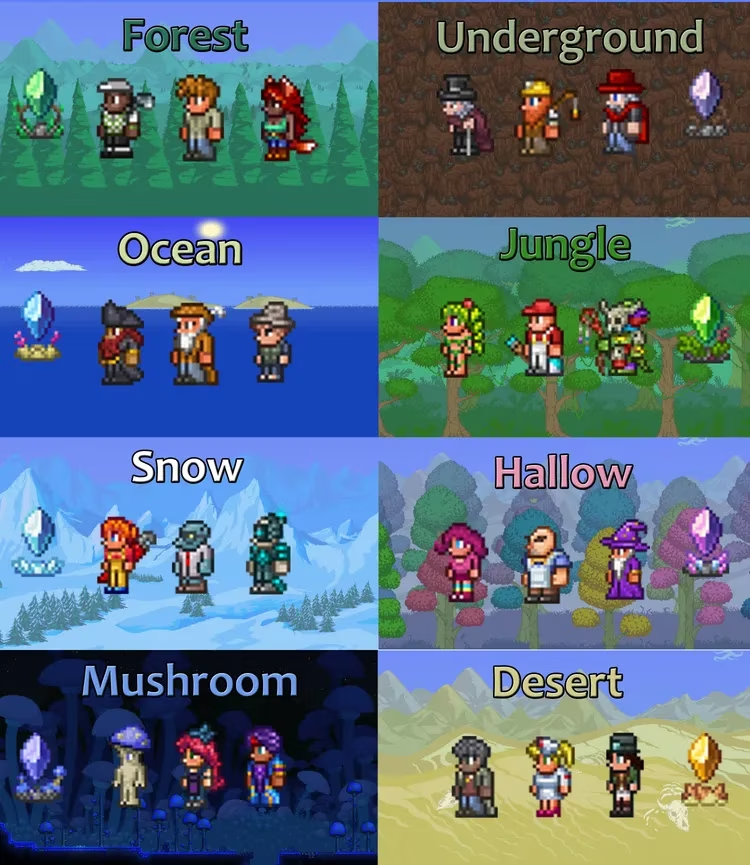
My personal setup has not changed much over the years. I start with a forest pylon near spawn, then expand to the desert, jungle, snow, and ocean as soon as I can manage housing. A classic early game pair is the Arms Dealer and Nurse in the desert. The Arms Dealer loves the desert, and the Nurse likes him well enough to make the duo work. For the jungle, the Dryad and Painter are a reliable combo. The Ocean can be handled with the Stylist and Dye Trader. In the cavern layer, I usually park the Demolitionist and Tavernkeep together. Once hardmode begins and the Hallow appears, I move the Wizard and Party Girl there for a quick hallow pylon.
At the end of the day, pylons are the best fast travel system Terraria has ever had, and they reward players who enjoy the game's social-simulation side. If you have been ignoring the Happiness system, you are leaving speed and convenience on the table. In 2026, with all the post-launch patches and polish, there has never been a better time to build your own glowing highway across every biome.