
Once upon a time—specifically May 16, 2011—a small independent developer named Re-Logic pressed the big red button and released Terraria on Steam. Within a week, the game had "shipped" more than 200,000 copies. That was not a bad start for a title that many observers immediately dismissed as a 2D Minecraft clone. In 2026, that dismissal looks about as accurate as calling a smartphone a fancy telegraph. Terraria is still here, still cheap, still absurdly deep, and still convincing players to build a house for a talking guide who refuses to stop opening doors. Who could ask for more? 🤔
A 2D Minecraft Clone? Sure, and a Ferrari Is a Horseless Carriage 🚗
Some people called Terraria a 2D Minecraft clone back in 2011. That label was not entirely fair, and more importantly, it was not even a bad thing. Mojang's blocky juggernaut had obviously influenced Terraria's design—there is a day/night cycle, for example, and night brings out much more dangerous critters that want to ruin a peaceful mining session. But where Minecraft focused on mining and building, Terraria's gameplay was much more of an action RPG. Players explored, fought, mined, and built in order to upgrade their gear and attract the most useful NPCs to move into their well-appointed structures. That's right: build it, and they will come. Usually with a merchant, a nurse, and a demolitionist who is far too excited about explosives. 💥
What Players Actually Do in Terraria (Besides Dying to Boulders)
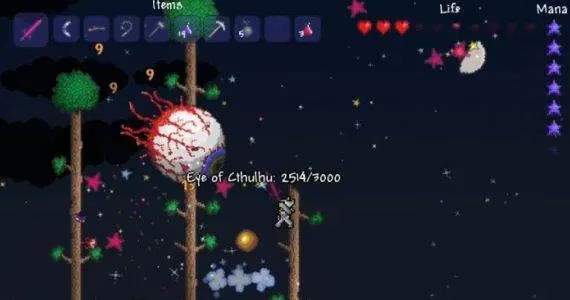
In 2026, the core loop remains gloriously ridiculous. A player spawns into a randomly generated world, chops down a tree, builds a workbench, and within an hour is likely fighting a giant eyeball with a laser pistol. Where else can someone hack a slime apart with a sword before shooting the Eye of Cthulhu with a laser pistol? Nowhere respectable, that's where. The original release already offered multiplayer, surface and cavern exploration, boss-summoning, deep gear-crafting, and structure-building systems. It was a sandbox, an RPG, and a base-building game all crammed into a pixel-art package that cost $10 in the United States. A four-pack cost $30, which meant friends could be dragged into the chaos for the price of a few sandwiches. 🥪
From $10 Curiosity to 2026 Juggernaut 📈
The graphical limitations may have been a turn-off to some players in 2011. Sandbox games do not appeal to everyone, either. But Minecraft had already proven that there was a healthy market for games like Terraria. And Terraria had one more trick up its sleeve: planned free updates throughout the title's life cycle. That was perhaps the strongest selling feature of all. It can only get better, the developers promised. In 2026, that promise has been kept so thoroughly that it borders on showing off.
Here is a quick look at how far the little 2D upstart has come:
| Feature | 2011 Terraria | 2026 Terraria |
|---|---|---|
| Price | $10, or $30 for a four-pack | Still famously affordable, often on sale |
| Updates | Free updates planned | More than a decade of free content, with the 1.4.5 era continuing the tradition |
| Bosses | Eye of Cthulhu and friends | A museum's worth of bosses, plus modded nightmares |
| World generation | Randomly generated | Randomly generated with seeds, secret seeds, and community challenges |
| Multiplayer | Supported | Supported, plus massive modding scenes and dedicated servers |
| Graphics | Pixel art that some found limiting | Pixel art that now looks like beloved retro charm |
Are the Graphics Still a Turn-Off? In 2026, They Are a Badge of Honor 🎨
It is true that sandbox games are not for everyone. It is also true that some players will look at Terraria's pixel art and sniff dismissively. But those players are missing the point. The game's visuals are not a limitation anymore; they are a signature. The real draw has always been the systems: the crafting trees, the boss progression, the NPC housing requirements, the randomized worlds, and the endless desire to see what is inside that glowing chest in the underground jungle. Terraria does not need ray tracing. It has a sword that shoots cats. What more could a reasonable person want? 🐱🗡️
The Free Update That Kept On Giving 🎁
Re-Logic's original plan for free updates was smart in 2011 and legendary by 2026. While other games charge for every new hat, Terraria has spent years expanding its world, adding bosses, items, biomes, quality-of-life features, and cross-platform improvements. The modding community, powered by tools like tModLoader, has turned the game into an infinite content machine. Players who bounced off the original release because of its graphics or difficulty now have thousands of hours of reasons to return. The title that was once a curious $10 experiment is now a permanent fixture in the indie pantheon.
So, in 2026, is Terraria still worth a player's time? Only if they enjoy exploring randomly generated worlds, building absurdly fancy houses for ungrateful NPCs, and shooting eldritch eyeballs with laser pistols. Which is to say: yes, obviously. The 2D Minecraft clone grew up, refused to stay in Minecraft's shadow, and became something far stranger and far more wonderful. And it only took one guy with a knowledge of Java—well, okay, a whole team, but the spirit is the same. 🎮