
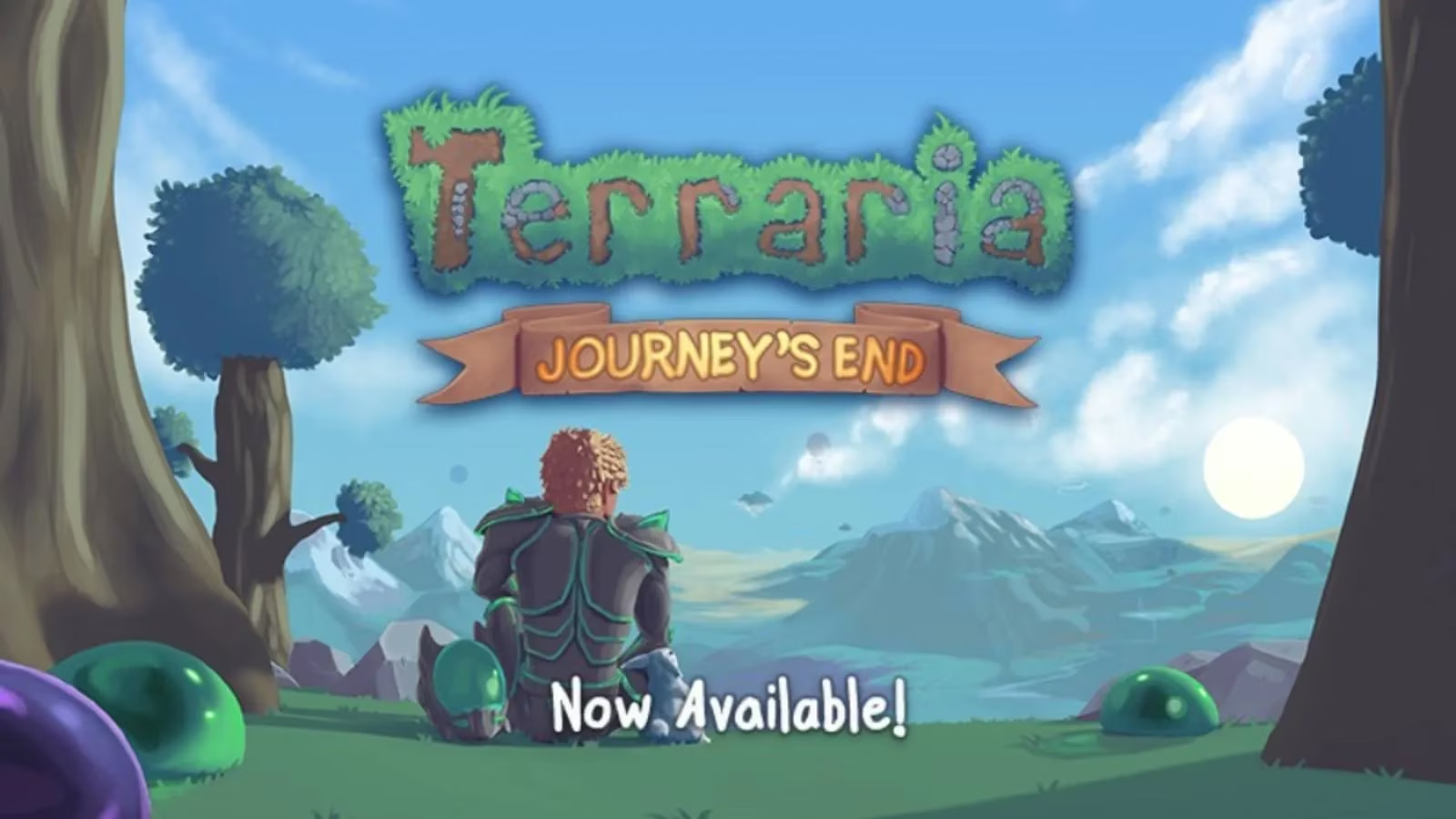
I still recall the crisp digital morning when Terraria whispered its final monument to my PlayStation 4. It was late September in the year 2021—though I write this from the quiet vantage of 2026, the memory glows like a lantern in a dark cavern. Over a year of patient hunger separated the PC faithful from us console miners and builders. The 1.4 update, that grand Journey's End, had finally crossed the threshold, and with it, the world of blocks and blades bloomed into something far more alive, more treacherous, and more absurdly delightful than I had ever dared hope. The air felt charged, as if every pixel had been repainted by a sunrise. I still call that feeling the bloom of the void, an invisible blossom that opens only when a game becomes exactly what it was always meant to be.
The Beckoning of Journey Mode
Before the update, I shaped my worlds with rough hands and stubborn will. But Journey Mode offered something entirely new: a painter’s palette that could transform the canvas of existence. It wasn’t merely a difficulty setting—it was an invitation to become a gentle god. In this mode, I could adjust time itself, freeze the sun at golden hour, duplicate any item once I had researched it, and even set the weather to a perpetual rain of slimes. It felt like being handed a conductor’s baton for a symphony that had always played just beyond my reach. I remember thinking, this is not cheating; this is choreography. The creative freedom was as vast as the sky islands I had once struggled to reach, and it breathed a second life into every build I’d ever abandoned.
Master Mode: The Heartbeat of the Abyss
But for every painter, there must be a warrior. Master Mode was the answer to that buried desire for absolute peril. It was not simply a harder difficulty—it was Terraria distilled into its most vengeful form, a gauntlet where every slime could shatter your bones if you blinked. The patch notes, which I still have etched in memory like runes on a sword, called it “a next-level challenge intended for those skilled, brave, or foolish enough.” I was all three. The first night, a pack of zombies pulped me thrice before dawn; I laughed with the wide-eyed thrill of a moth flirting with a bonfire. Master Mode didn’t just test my reflexes—it taught me that survival is a kind of poetry, a rhythm of dodges and counterstrikes that turns the world into a brutal sonnet. The new bosses, those final nightmares that joined the pantheon, danced with a cruelty I had only known in myth. Each victory felt less like a win and more like a treaty signed with the darkness.
The Unlikely Grace of Block Swap
Some innovations arrive with a fanfare; others slip into your life as quietly as morning mist. Block Swap was the latter, and it changed everything. Before 1.4, upgrading a humble dirt hut to a marble palace required demolition—hours of hammering down walls, only to rebuild them with trembling fingers. But with Block Swap, I could simply pick a new block and place it directly over the old one, as if the world were a layered dream ready to be reshaped. It worked on chests too, without spilling their hoarded treasures. I came to think of it as the ghost of the architect’s intent, a silent companion that understood my renovation before I had fully formed the thought. In the years since, no quality-of-life feature ever felt so much like a love letter. I'd catch myself whispering to the screen, “How did I ever live without you?”
Void Vault: A Familiar Made of Shadow
Inventory management in Terraria was always a peculiar purgatory—a thousand tiny decisions between carrying treasure or breathing room. The Void Vault, paired with the Void Bag, arrived like a loyal phantom butler. When my pockets overflowed, excess items simply vanished into the void at home, stored without complaint. The patch notes described it as an “automagical inventory overflow vacuum,” and that whimsical word was perfect. To me, it became my pocket of folded silence, a dimension stitched into my belt that gobbled up ores, banners, and potions, leaving my mind free to wander the present moment. No more frantic trips back to base, no more agonizing sacrifices. It was as if Terraria finally respected that adventure lives in the journey, not in the inventory screen.
The Graveyard Biome: A Chill That Sings
Too many tombstones in one place, and the world remembers death. The Graveyard Biome emerged from that sorrowful mathematics, a mist-cloaked valley where the air grew cold and the music turned to a spectral dirge. I discovered it by accident, after a particularly disastrous encounter with a new Master Mode boss. Half a dozen gravestones huddled together, and suddenly the grass grayed, the sunlight dimmed, and strange fog coiled like drowned breath. The patch notes warned, “what mysteries will you find buried six feet deep?” I found secrets—crafting recipes available only in that haunted soil, enemies twisted by grief, and a profound sense that Terraria’s world was more alive because it could mourn. The Graveyard was not just a biome; it was the game’s elegy, a place where loss became landscape. I often return there now, in my 2026 worlds, to sit beneath the weeping trees and remember all the characters I’ve buried across a decade of adventures.
Golf: The Quiet Joy of a Lost Ball
Among the thousand new items and the epic boss fights, nothing tickled my sense of the sublime like Golf. Journey’s End introduced an entire mini-game complete with clubs, scorecards, and the ability to design custom courses. I spent a full afternoon carving a fairway through a jungle, placing sand traps like little suns of defeat. Friends joined, and for an hour we were no longer warriors—we were eccentric lords of a pixel realm, measuring drives over lava pools and cursing the wind. The golf ball became a wandering moonlet, tracing parabolas that felt impossible and yet lived in the game’s physics. It was, I think, the developers’ wink, a reminder that even at the end of all things, joy is found in the smallest absurdities.
The Flood of New Content: A World Rewritten
Journey’s End did not merely add—it overhauled. Over a thousand new items swelled the catalog past five thousand, each one a tiny story waiting to be worn, swung, or placed. New critters scuttled into existence, from the shimmering fairy to the grumpy gnome. The blood moon grew fatter with horrors, and lava fishing became a fever dream of hellish catches. Two new boss encounters—I will not spoil their names for the uninitiated—redefined what it meant to be tested. And the music, ah, the new soundtrack was an orchestra of pure adventure. The patch notes spoke of a “full rebalance pass on enemies and items,” and indeed, no gear was left untouched. Even my old Shadow Armor felt renewed, like a well-loved coat lined with fresh silk. Starting a new playthrough became mandatory, a pilgrimage through a world that was both intimately familiar and thrillingly alien.
The Console-Specific Alchemy
The update didn’t merely port PC features; it translated them with a craftsman’s care. Horizontal and vertical splitscreen toggles meant that my partner and I could build side by side without bending our necks. Revised gamepad mappings—offering Console Legacy, Advanced, and Simplified profiles—felt like a tailor adjusting the seams of my armor. The user interface shifted to accommodate the flood of Journey’s End features, and dozens of new settings let us fine-tune the graphical quality until the pixels sang. It was, I realized, a love letter wrapped in a toolkit. The developers had not forgotten the tactility of a controller, the specific magic of a console huddled beside friends on a couch.
The Weight of a Final End
Journey’s End was called the “final major expansion,” and for a long while I grieved the silence that followed. But from 2026, I see it differently: the game did not end; it crystallized into a perfect form. Every block, every boss, every hidden biome is now a polished gem in a crown that no longer grows heavier. The update was not a conclusion but a consummation—a world that said, “Now you have all the tools, go make your own adventures.” And so I have, for five years, with the same wonder that lit my first night in a wooden box while zombies moaned outside. The features I’ve described—Journey Mode, Master Mode, Block Swap, Void Vault, the Graveyard, Golf—they are not bullet points on a fading patch note. They are the lungs of a living world that I still breathe.
In the quiet of this late afternoon, I load a world that began in 2021, walk past the golf course where my friends no longer visit, pay respects at the Graveyard’s misty edge, and swap a few blocks from stone to starry nebula. The Void Bag hums against my hip. A boss trophy gleams on the wall. I swing a club, and the ball arcs like a wish toward the crimson horizon. And I know, with a certainty as steady as the guide’s first advice, that some journeys do not end—they simply learn to wait.